No, the translation management system is not dead, but its job is changing. AI agents, large language models, low-code automation, and open APIs have made it possible to run translation without a traditional TMS at the center, an approach often called headless localization. For many teams, the right answer in 2026 is a hybrid: use agents and APIs for speed and flexibility, and keep a platform for the things that still need a hub, such as translation memory, human review, role-based access, quality reporting, and audit trails.
This guide explains what headless localization is, why the debate is happening now, where each approach wins and fails, and how to decide for your own team.
What is headless localization?
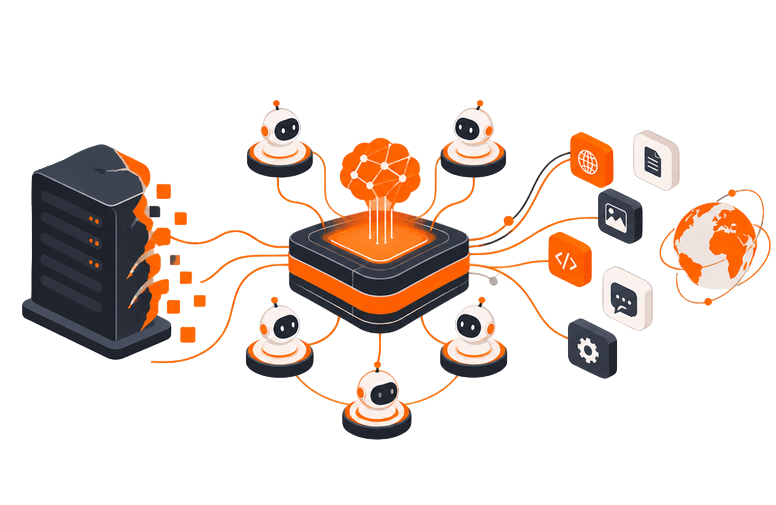
The term comes from content management. A headless CMS separates where content is stored from where it is displayed. In localization, headless means separating the orchestration of translation work from a single all-in-one tool. Instead of one platform that does everything, you connect specialized components through APIs: something that detects new content, something that routes it, one or more translation engines or language models, a review interface, quality checks, and delivery back to the source system.
Headless does not mean there is no project management, no memory, and no human review. It means those functions are delivered as separate services rather than as features of one product. An August 2026 analysis from the training provider TranslaStars frames it the same way, as a different architecture rather than the absence of a TMS (TranslaStars, August 2026).
Why the question is being asked now
Four forces came together in the past two years.
- Language models improved quickly. For many content types and language pairs, AI drafts are now good enough to change how work is routed, which shifts the human role from translating to reviewing and supervising.
- AI agents can run steps on their own. Agents can detect changes in a repository or CMS, call a translation model, check the result against a glossary, and request review, without a person managing each file.
- Low-code and API tooling matured. Teams can wire together a working pipeline in days rather than months.
- TMS vendors are not always fast enough. When a better model appears, a team on a platform may wait for the vendor to integrate it. A 2024 Slator survey, as cited in the TranslaStars analysis, reported that 48% of localization buyers said their TMS needed improvement and 16% were fully satisfied.
Industry news points the same way. A MultiLingual roundup for the week of September 29 to October 3, 2026 describes a sector moving toward more governed, outcome-driven language systems, with investment in infrastructure that reflects operational scale and linguistic reality (MultiLingual, October 3, 2026). Governance is the word to remember. We return to it below.
What a TMS still does better than anything else
A platform is not an outdated idea. It has lasted because it solves problems that are hard to rebuild.
- Translation memory and terminology at scale. For repetitive content such as manuals, software strings, and standard contracts, a well-kept memory and glossary cut cost and keep wording consistent across languages and years.
- A single workspace for reviewers. Linguists, project managers, and reviewers work in one interface with context, comments, terminology, and quality warnings. This is the hardest piece to replace.
- Out-of-the-box reporting. Stakeholders want volume, cost, turnaround, and quality by language and project, without engineering work.
- Roles, approvals, and audit trails. Who translated, who reviewed, who approved, and when. Regulated and contract-heavy content depends on this.
- A mature ecosystem. Connectors, trained linguists, and established procedures reduce the risk of running a large program.
For a refresher on what a platform includes, see our guide on what a translation management system is and whether you need one, and our overview of the key features and benefits of a TMS.
Where headless and AI-agent workflows win
- Speed of adopting new models. Swapping one API endpoint is faster than waiting for a vendor release cycle.
- Flexible routing. You can send marketing copy to one model, technical text to another, and short UI strings to a cheaper one, based on rules you control.
- Usage-based cost. Costs follow actual volume instead of fixed seats, which suits teams with fluctuating demand.
- Fit with continuous content. Product and web content now changes daily. A pipeline triggered by a content change suits that better than project-by-project handoffs.
- Data ownership. Memories and glossaries can live in your own infrastructure.
Where headless breaks down
- The review experience. Linguists need a proper editor with context, glossary, and quality checks. Teams that underestimate this end up with frustrated reviewers and weaker quality.
- Translation memory. Without a memory layer, every repeated sentence becomes a new model call. Some teams rebuild memory with semantic search, which can work well but must be designed and maintained.
- Reporting. Dashboards must be built and kept accurate.
- Security and compliance. Each added tool is another place where data travels. Audit trails, access control, and data residency have to be designed across components.
- Maintenance and key-person risk. Someone has to keep the pipeline running. If that person leaves, so can your knowledge of how it works.
Side by side: TMS, headless and hybrid
| Dimension | Traditional TMS | Headless / agent pipeline | Hybrid |
| Setup effort | Moderate, mostly configuration | Higher, requires technical skills | Moderate to high |
| Adopting new AI models | Depends on vendor | Fast | Fast for automation, stable for review |
| Human review experience | Strong, built in | Must be built or borrowed | Strong, via the platform |
| Translation memory | Built in | Must be rebuilt or connected | Platform memory plus extensions |
| Reporting | Built in | Must be built | Combined view |
| Audit trail and approvals | Built in | Must be designed | Platform for regulated work |
| Cost pattern | Licenses, often per seat | Usage plus engineering and upkeep | Mixed |
| Best for | Many linguists, regulated content, agencies | Technical teams, continuous content, small review teams | Most mid-size and enterprise teams |
What the cost numbers say, and what they do not
The TranslaStars analysis modeled a team of 10 users handling roughly one million words per year over three years. It estimated a total of about 100,000 euros for a TMS and about 71,000 euros for a headless build, with the headless version carrying higher maintenance cost, and it put the break-even near 15 users or about one million words per year. It also noted that below those levels a TMS is likely to be cheaper and easier.
Treat these figures as one illustration, not a rule. They come from a training company with its own assumptions, and your costs will depend on engineering salaries, volume, language mix, review needs, and compliance. The useful takeaway is the shape of the trade-off: headless shifts spending from licenses to engineering and maintenance, and it pays off mainly at larger or more technical scale.
Governance is the deciding factor
As AI takes on more of the translating, the questions that matter most are about control.
- Accountability. Who is responsible for the final text, and where is the human decision recorded?
- Traceability. Can you show which model or engine produced a segment, who edited it, and who approved it?
- Data handling. Where is content sent, stored, and retained, and can sensitive content be kept away from certain models?
- Consistency. Are glossaries and style rules enforced automatically rather than by hope?
- Measurement. Can you track quality and cost over time, by content type?
A hub that records these decisions is hard to give up. That is why we expect the platform to remain, with a different emphasis: less about moving files between people, more about governing a mix of people, engines and agents.
Who should choose what
| Your situation | Likely best approach | Why |
| Small team, modest volume, few languages | Simple platform or managed service | Setup effort for a custom pipeline rarely pays back |
| Technical team, fast-changing product content | Hybrid, leaning headless | Automation for speed, a platform for review and memory |
| Language service provider with many linguists and clients | Platform | Roles, vendor management, billing and reporting are core needs |
| Enterprise with regulated content | Platform or hybrid | Audit trails, approvals and data controls come first |
| Large archive of translation memory plus engineering capacity | Hybrid | Keep and extend the memory, automate the routine |
What to demand from a localization platform in 2026
If you stay with a platform, make sure it behaves like a hub with open edges rather than a closed box. Ask whether it offers:
- Open APIs and webhooks so content and results can flow in and out of other systems.
- Engine and model choice, with the ability to switch without a migration project.
- Support for LLM-based translation and post-editing with rules for what gets human review.
- Access for automation and agents under proper permissions.
- A strong human review editor with terminology, context, and quality checks.
- Automated quality checks and clear quality reporting.
- Role-based access, approvals, and audit trails.
- Portable data, meaning you can export memories and glossaries in standard formats.
- Transparent cost reporting by project, language, and content type.
- Security controls that match your content sensitivity.
Our guide on how to choose the best TMS goes deeper on evaluation.
Five steps to a hybrid setup
- Sort your content by risk. Separate content that can be fully automated from content that needs human review and content that must be approved with an audit trail.
- Keep one source of truth for memory and terminology. Decide where translation memory and glossaries live, and make sure every tool reads from the same source.
- Automate intake and delivery. Trigger translation when content changes, and push approved text back to the source system.
- Route by rule. Choose engines or models by content type and language, and define when a human must review.
- Measure from day one. Track cost, turnaround, rework, and quality by route so you can adjust the rules.
How MarsHub fits
MarsHub builds for the hybrid reality. MarsCloud is our cloud translation management system for enterprises, language service providers, and linguists. It lets teams manage projects, suppliers, and clients, run custom workflows with roles and approvals, choose among machine translation engines and LLM-powered translation, route output to expert post-editors, keep translation memory per project, and run quality checks, with API access for connecting existing content workflows. See the full feature overview.
For teams that want AI speed with oversight, MarsRelay is a managed AI translation service that pairs LLM translation with a dedicated project manager, locked terminology, and translation memory matching. MarsAlign helps teams build translation memory from existing bilingual documents, which is useful when you want to bring an archive into a new workflow. You can also read how we think about AI and human collaboration in localization.
A 60-day pilot to settle the debate
Instead of debating architecture in the abstract, test it.
Weeks 1 and 2. Choose two content streams, one high-volume and low-risk, one high-risk. Define success: cost per accepted word, turnaround, rework rate, and an agreed quality score.
Weeks 3 to 6. Run both streams through your current process and through a hybrid route that adds automation and AI with human review. Keep terminology and memory identical across both.
Weeks 7 and 8. Compare results, including the effort your team spent on setup and maintenance. Decide which content moves to the new route, which stays, and what to build or buy next.
Frequently asked questions
What does headless localization mean?
It means running translation workflows through separate, API-connected components rather than a single all-in-one platform. Routing, translation, review, quality checks, and delivery become independent services.
Will AI agents replace translation management systems?
Agents can automate many steps, but organizations still need a place to manage memory, terminology, human review, permissions, and audit records. In most cases, agents will work with a platform rather than instead of one.
Is a headless setup cheaper than a TMS?
Sometimes, at larger scale or with strong in-house engineering. It replaces license fees with development and maintenance costs, so the answer depends on your volume, team, and compliance needs.
What happens to my translation memory if I leave a platform?
That depends on the platform and the formats it supports. Before you commit to any system, ask how memories and glossaries can be exported in standard formats, so you keep control of your linguistic assets.
Do small teams need a TMS?
Not always. If you translate small volumes into a few languages, a simpler setup or a managed service may be enough. A platform becomes more valuable as languages, content changes, and contributors grow.
Next step
Want to test a hybrid workflow on your own content? Talk to the MarsHub team about a pilot, and we will help you map your content, review needs, and governance requirements before you commit to anything.
Sources and notes
- TranslaStars, “Localization Events 2026” analysis of headless localization, August 2026, including the cost model and the Slator 2024 survey figures it cites.
- MultiLingual, “The Week in Review: Language Industry News, September 29 to October 3,” October 3, 2026.
- Slator, report on the launch of MarsRelay, 2026.
- Cost figures are illustrative and based on the assumptions in the source analysis.



 contact@marshub.com