Managed AI translation services are changing how businesses think about multilingual content. Businesses used to choose between two options a free AI tool or a slow, expensive agency. Now there’s a third option. AI engines translate the content. A dedicated project manager runs the process around them. This single shift adds real human management to AI output. It’s why leading language services groups have rebuilt their service model around it.
What Are Managed AI Translation Services?
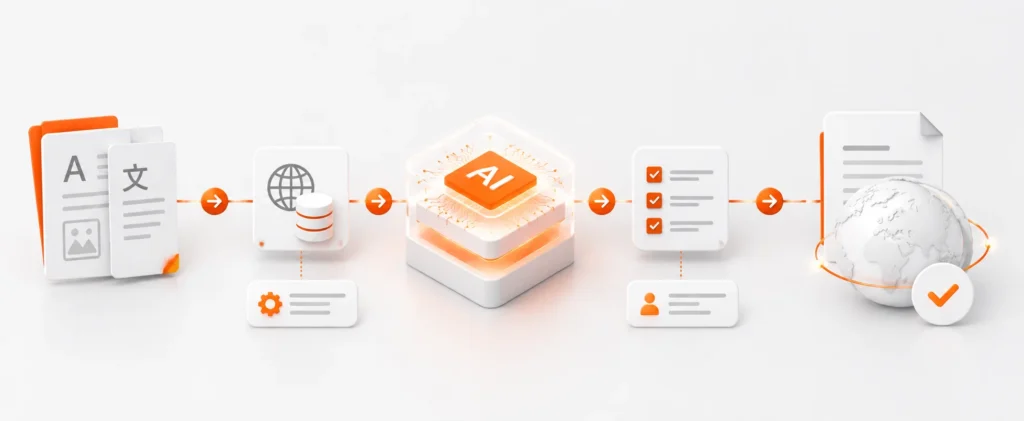
Managed AI translation services combine two things that used to live in separate worlds. First, an AI engine translates the content itself, quickly and at scale. Second, a dedicated project manager (PM) owns everything around that translation. The PM locks terminology, checks quality, and signs off before anything ships. Neither piece works well alone. AI alone drifts. A PM without AI can’t keep up with volume. Together, they solve both problems at once.
The Gap Unmanaged AI Translation Leaves Open
An AI engine has no memory of your brand. It doesn’t know how your team translated the company name last quarter. It can’t confirm whether legal already approved a specific term. And it can’t judge which of three equally fluent translations actually matches your brand’s voice. This isn’t a flaw in the technology. That’s just not what a translation engine does.
Left unmanaged, this gap causes a specific problem terminology drift. Small inconsistencies build up quietly across a growing library of content. Nobody notices at first. Then a customer flags something. Or a legal term shows up two different ways in related documents. By the time anyone catches it, the inconsistency has already spread across dozens of files.
How Managed AI Translation Services Actually Work
A managed workflow puts a project manager in charge of the full process, not just a final check. Here’s what that typically includes:
1. Lock the Glossary First
The PM confirms a Glossary of Record before translation starts brand terms, product names, and industry vocabulary. Every document then works from the same approved terminology from day one.
2. Manage Translation Memory Actively
The PM matches and reuses previously approved content automatically. This keeps approved language consistent, even as your content library grows.
3. Route AI Engines by Language Pair
Different engines perform differently across languages. The PM routes each project to the engine best suited for that pair. This improves output quality before human review even begins.
4. Layer Automated QA Before Human Review
An automated layer checks output against the glossary and source content. It flags formatting issues and terminology drift. The PM then reviews exactly what’s flagged, concentrating judgment where it’s actually needed.
5. Sign Off With Real Accountability
The PM approves final delivery and stays your point of contact going forward not just for one file.
That’s the real definition of “managed” a named person accountable for the process, start to finish.
Common AI Content Problems And How Managed AI Translation Services Solve Them
Most frustration with AI translation traces back to one root cause nobody is managing the output. Here’s what tends to go wrong, and how a managed model fixes it.
Terminology Drift
The same term gets translated differently across documents, batches, or even AI engines. A locked glossary, maintained by the PM, fixes this every document works from identical approved terminology.
Brand Voice Erosion
Content can be fluent sentence by sentence and still drift from your brand’s tone over time. Translation memory reuses approved phrasing. The PM also reviews flagged content to catch voice drift before it spreads.
No Accountability
A fully automated pipeline has nobody to call when output is wrong. A named PM signs off on every delivery and owns the outcome not an anonymous API response.
Unclear Data Handling
Many AI tools don’t disclose what happens to submitted content. Managed AI translation services run on private, enterprise-licensed infrastructure instead. A documented zero-data-retention policy means nobody stores your content or uses it to train other models.
Why Multi-Brand Groups Rely on Managed AI Translation Services
A group might run several language service brands high-volume translation, technical localization, and full human translation for sensitive work. Managed AI translation benefits every brand as shared infrastructure, not a single feature. A locked terminology system and PM-led review can scale consistently across every brand in the group. That’s why a unified group tends to deliver steadier quality than separate, disconnected services.
It also lets a group match oversight to risk. A high-volume product catalog and a legal tender document both benefit from managed AI translation. But the PM scrutinizes each one differently, based on the stakes involved.
Pricing, Time, and Quality: Comparing Your Options
| Pure AI / MT Tools | Managed AI Translation | Traditional Agency | |
| Pricing | Lowest cost | Efficient scaled pricing without full agency overhead | Highest cost, scales linearly with volume |
| Turnaround Time | Fastest, but unreviewed | Fast AI throughput with PM oversight built in | Slowest limited by human translator capacity |
| Terminology Consistency | Unreliable, drifts over time | Guaranteed via locked glossary, maintained by a PM | Strong, but slower to scale |
| Accountability | None | Dedicated PM accountable for every project | Full human accountability, but at limited scale |
| Best For | Low-stakes, disposable content | High-volume content that still has to be accurate | Small volume, maximum nuance |
This comparison explains why managed AI translation services have become the default choice for most business content. It’s too much volume for a manual pipeline alone, but too important to leave unsupervised.
What Scale Actually Requires
Delivering large volumes of translated content on tight deadlines takes more than AI speed alone. Nimdzi tracks this benchmark industry-wide in its annual ranking of the 100 largest language service providers. Neither unmanaged AI nor a fully manual pipeline can hit it alone. It takes both pieces together AI for throughput, and a PM for the consistency throughput alone doesn’t guarantee.
It’s easy to assume “AI-powered” means a trade-off between speed and quality. In a genuinely managed model, that trade-off doesn’t have to happen. The management layer is specifically what prevents it.
What to Look for in a Managed AI Translation Services Provider
A few direct questions separate a genuinely managed provider from one that just uses the term as marketing language:
- Does the provider confirm a locked glossary before translation starts, specific to your terminology?
- Is your point of contact a named, consistent PM or a different person every project?
- Does a real person review flagged content, or does automation handle quality assurance alone?
- Can the provider show independently verifiable scale, not just self-reported numbers?
- What’s their actual, contractual data handling policy?
(If you’re comparing providers directly, our [full breakdown of the five-step managed translation process] walks through each stage in more detail.)
The Bottom Line
Managed AI translation services exist because AI engines are a genuinely powerful tool, but a tool isn’t a process. Left alone, AI output drifts in ways that stay invisible until they’ve already become a problem. A dedicated project manager closes that gap. They lock terminology, manage consistency, and review what needs human judgment. That holds true whether it’s one project or millions of words. For businesses choosing a language partner, that management layer is the real differentiator now. It’s not which AI engine does the translating it’s who’s accountable for what it produces.
Frequently Asked Questions
What are managed AI translation services?
Managed AI translation services combine AI-driven translation with a dedicated project manager. The PM locks terminology, manages translation memory, and reviews flagged content. They also sign off on final delivery, rather than letting AI output ship without oversight.
Why do language groups offer managed AI translation instead of just AI translation?
Because unmanaged AI output drifts in terminology and consistency as volume grows. A dedicated PM prevents that drift. They control terminology and review flagged content before delivery something raw AI translation can’t do alone.
How does a multi-brand group benefit from managed AI translation services?
Shared infrastructure, locked terminology, translation memory, and PM-led review scales consistently across every brand in the group. Different content types get an appropriate level of oversight this way, without running as separate, disconnected processes.


 contact@marshub.com